How to Choose a Digital Multimeter for College Labs and Student Electronics Kits
June 25th , 2026 | AstroAI *
Buying Guide • Digital Multimeters • Student Electronics Kits
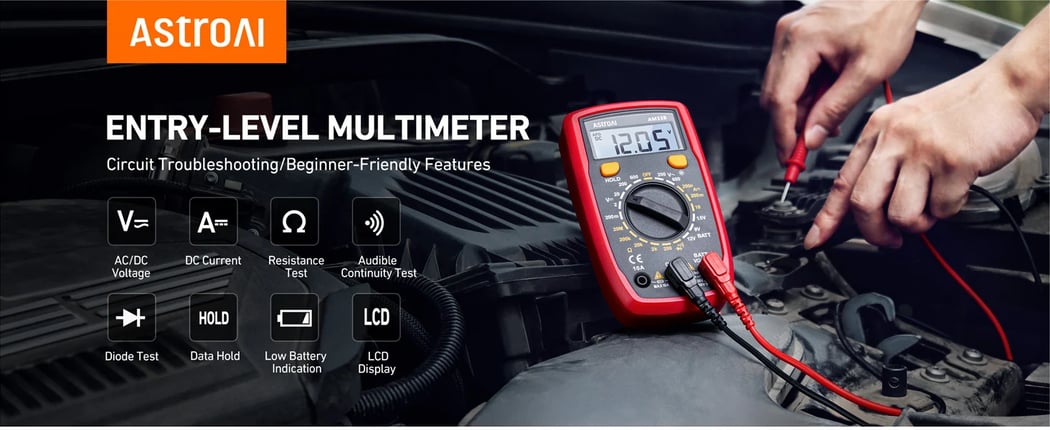
How to Choose a Digital Multimeter for College Labs and Student Electronics Kits
College labs and student electronics kits need multimeters that are easy to teach, consistent across many benches, durable enough for repeated handling, and practical for low-voltage circuits, continuity checks, resistance labs, battery testing, and basic troubleshooting. For most introductory classroom kits, AstroAI AM33B is the simpler starting point. For labs that need more capability in one student meter, AstroAI DM130B adds a 4000-count display, auto/manual range, NCV, capacitance, and 1.5V/9V/12V battery testing.
Quick Answer: What Should a College Lab Buy?
Choose AM33B for large introductory kits where students mainly learn voltage, resistance, continuity, diode testing, current basics, and manual range selection. Choose DM130B when the course needs a more flexible classroom meter with 4000 counts, auto/manual range, NCV detection, capacitance, and battery testing. Many programs can standardize beginner stations around AM33B and reserve DM130B for advanced benches or instructor kits.
- Best fit for first-year labs: AM33B, because it keeps students focused on core measurement habits.
- Best fit for upgraded student kits: DM130B, because it adds auto range, NCV, capacitance, and battery testing.
- Procurement note: avoid public customer-name claims unless the buyer has approved the reference.
AstroAI Recommendations First
Match the meter to the course level, not just the display count.
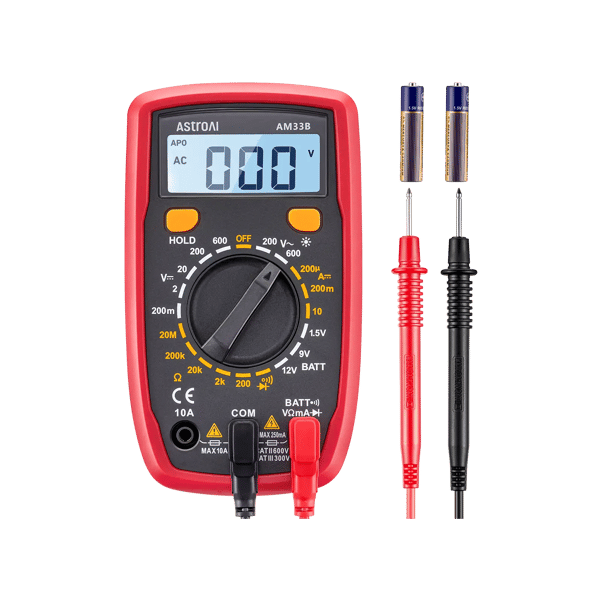
Introductory classroom kit
AstroAI AM33B - 2000-Count Manual-Range Multimeter
Best for beginner labs, student kits, continuity practice, resistor labs, diode checks, and low-voltage classroom exercises.
- 2000-count display
- Manual range selection
- AC 600V / DC 600V voltage range
- DC current up to 10A
- Resistance up to 20M ohm, continuity, diode test, hFE, backlight, Data Hold, and low battery indicator
- Pros: simple enough for large beginner kits and range-selection teaching.
- Cons: fewer convenience features than an upgraded student lab meter.
- Not best for: classes that need NCV, capacitance, auto range, or battery-test modes.
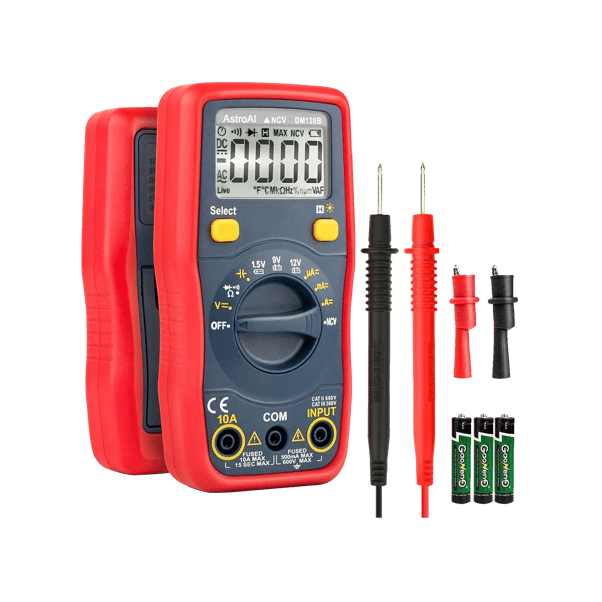
Upgraded student lab kit
AstroAI DM130B - 4000-Count Auto/Manual Multimeter
Best for electronics classes that need a more flexible student meter for mixed circuit labs, battery checks, and basic diagnostics.
- 4000-count display
- Manual and auto range selection
- AC/DC voltage and AC/DC current
- Resistance, continuity, capacitance, NCV detection, and 1.5V/9V/12V battery test
- Auto power-off after about 15 minutes of standby; backlight turns off after about 30 seconds
- Pros: stronger feature coverage for mixed classroom and lab use.
- Cons: more feature-rich than some first-week beginner lessons require.
- Not best for: courses that intentionally want only manual-range basics.
1. What College Labs Actually Need in a Multimeter
A lab multimeter is different from a one-off personal tool. It needs to be teachable, repeatable, labeled clearly, and realistic for the measurements students perform every week. For electronics classes, the highest-value functions are usually AC/DC voltage, DC current, resistance, continuity, diode testing, a readable display, overload indication, and a power source that is easy for staff to maintain across many units.
| Lab need | Why it matters | Best fit |
|---|---|---|
| Basic circuit learning | Students learn range selection, probe placement, polarity, and reading habits. | AM33B |
| Mixed electronics labs | Auto range, capacitance, NCV, and battery testing reduce tool switching. | DM130B |
| Bulk kit consistency | The same model across benches makes instructions, grading, and troubleshooting easier. | AM33B for intro; DM130B for upgraded kits |
| Lab staff support | Auto-off, backlight, standard batteries, and visible overload indication reduce avoidable support issues. | DM130B when convenience matters |
2. AM33B vs DM130B: Classroom Comparison
AM33B and DM130B both fit education use, but they solve different classroom problems. AM33B is better when the goal is to teach fundamentals without feature overload. DM130B is better when instructors want one meter to cover beginner work plus battery testing, NCV awareness, capacitance, and auto range convenience.
| Feature | AM33B | DM130B | Classroom meaning |
|---|---|---|---|
| Display count | 2000 counts | 4000 counts | DM130B gives finer display resolution. |
| Range type | Manual | Manual and auto | AM33B teaches range selection; DM130B speeds routine measurements. |
| Voltage | AC 600V / DC 600V | AC 600V / DC 600V | Both cover common lab voltage lessons. |
| Current | DC 10A | AC/DC current | DM130B covers broader current exercises. |
| Resistance | 20M ohm | 40M ohm | Both fit resistor labs; DM130B extends range. |
| Extra teaching features | hFE, diode, continuity, Data Hold | NCV, capacitance, battery test, auto range | DM130B fits broader lab modules. |
3. Deeper Recommendation Logic: Why These Two Models Work for Education
For college labs, the best meter is not always the most advanced meter. A classroom meter has to support repeated instruction, fast replacement, clear student handouts, and predictable answers across dozens of benches. AM33B and DM130B work well as a two-level education set because they separate two different teaching goals: learning how measurement works, and applying measurement across broader electronics tasks.
Why AM33B makes sense for first-year benches
AM33B keeps students close to the fundamentals. Manual range selection makes them think about expected voltage, current direction, resistance scale, and overload indication before writing down a number. That is useful in early labs where instructors want students to understand the meter instead of treating it as a black box.
Why DM130B makes sense for mixed lab kits
DM130B expands the measurement envelope without becoming too specialized. Auto range speeds routine checks, 4000 counts gives finer display resolution, NCV helps with voltage-awareness lessons, capacitance supports component labs, and 1.5V/9V/12V battery testing is practical for shared kits.
Why a two-tier kit can reduce friction
A single advanced meter for every student can add cost and unnecessary complexity. A single basic meter can limit advanced activities. A two-tier plan lets procurement keep most stations simple while giving instructors and advanced benches extra capability where it is actually used.
4. Use-Case Coverage: Where AM33B Ends and DM130B Starts
The biggest difference is not only 2000 counts versus 4000 counts. It is the range of lessons each meter can support comfortably. AM33B covers foundational measurement practice. DM130B reaches farther into project work, batteries, capacitance, and faster bench troubleshooting.
| Classroom task | AM33B coverage | DM130B coverage | Recommendation |
|---|---|---|---|
| Breadboard voltage and resistor labs | Strong fit for basic DC voltage, resistance, and continuity | Also fits, with faster setup through auto range | AM33B is usually enough. |
| Manual range and overload training | Best fit because students must choose the range | Can be used in manual mode, but auto range may hide the lesson | AM33B for fundamentals. |
| Capacitor and component identification labs | Limited for capacitance-focused modules | Better fit because capacitance is included | DM130B for broader electronics labs. |
| Battery stations and kit maintenance | Can check voltage manually | Adds 1.5V, 9V, and 12V battery-test modes | DM130B for shared lab support kits. |
| Maker spaces and open-ended projects | Good for basic checks and loaner pools | Better for varied users and mixed project types | Use both: AM33B as loaners, DM130B for advanced stations. |
5. Why Manual Range Can Be Good for First-Year Labs
Manual range is not automatically a disadvantage in education. In introductory circuits, it teaches students to estimate expected values, choose a safe starting range, recognize overload indication, and understand why the decimal point moves. That makes AM33B a sensible tool when the goal is measurement discipline rather than speed.
This matters because many first-year mistakes are not caused by the circuit itself; they come from measurement habits. Students may place probes in the wrong jack, choose current mode for a voltage measurement, read the wrong decimal position, or forget that resistance and continuity checks require a de-energized circuit. A simpler meter helps instructors isolate those lessons before adding convenience features.
6. When DM130B Is Worth the Upgrade
DM130B is a better fit when a lab wants one student meter to cover more than basic resistance and voltage. Auto range helps students get readings faster after they understand fundamentals. NCV supports voltage-awareness demonstrations, capacitance helps with electronics modules, and the 1.5V/9V/12V battery test is useful for lab maintenance and student kits.
The upgrade is especially useful in courses where the meter moves between structured labs and open-ended troubleshooting. In a design project, students may need to check a battery, verify a sensor supply, confirm continuity, identify a questionable capacitor, and then return to a voltage reading. DM130B covers more of that workflow without needing a separate specialty tester.
7. Bulk Purchasing Checklist for Labs and STEM Programs
Standardize the model
One model per course keeps instructions, lab handouts, troubleshooting, and spare parts simpler.
Match features to lessons
Do not buy features students will not use, but do not underbuy if the course includes capacitance, NCV, or battery testing.
Plan battery maintenance
AM33B uses two AAA batteries; DM130B uses three AAA batteries. Standard battery inventory matters at scale.
Keep mains work supervised
Student labs should emphasize low-voltage practice unless instructors, safety procedures, and rated equipment are in place.
8. Suggested Lab Deployment Plan
For a large education purchase, a two-tier model often works well: use AM33B for the majority of first-year stations, then add DM130B for advanced benches, instructor demos, electronics clubs, battery-testing stations, and shared troubleshooting kits. This gives students a consistent baseline while still supporting broader measurement tasks.
| Course or use case | Recommended meter | Why |
|---|---|---|
| Intro electronics | AM33B | Simple manual-range tool for core measurement habits. |
| Engineering design kits | DM130B | More flexible for mixed components, batteries, and troubleshooting. |
| Maker spaces and clubs | DM130B | Auto range and NCV support a wider range of unscheduled projects. |
| Large loaner pool | AM33B plus a smaller DM130B set | Balances simplicity, budget control, and advanced-feature access. |
9. Common Student Mistakes to Prevent
- Measuring current across a voltage source instead of placing the meter in series with the load.
- Leaving the red lead in the current jack after a current lab.
- Trying continuity or resistance on an energized circuit.
- Using the wrong range and misreading the decimal point.
- Testing mains circuits without supervision, training, or properly rated procedures.
Final Recommendation
Choose AM33B when the priority is a consistent, simple, large-volume student kit for basic electronics learning. Choose DM130B when the lab wants a more capable student meter with auto/manual range, 4000 counts, NCV, capacitance, and battery testing. For many college programs, the strongest deployment plan is AM33B for introductory stations and DM130B for advanced benches or shared troubleshooting kits.
View AM33B → View DM130B →Frequently Asked Questions
What multimeter should students use in an electronics class?
Most students should use a digital multimeter that covers AC/DC voltage, basic current, resistance, continuity, diode testing, clear display reading, and overload indication. AM33B fits introductory kits, while DM130B fits classes that need auto range, NCV, capacitance, and battery testing.
Is a 2000-count multimeter enough for college labs?
Yes, a 2000-count multimeter is enough for many introductory circuits, continuity checks, resistor labs, battery checks, and basic troubleshooting. It is not the right fit when students need finer resolution, auto range, capacitance, or NCV.
When should a lab choose a 4000-count multimeter?
Choose a 4000-count multimeter when the course needs finer display resolution, faster setup through auto range, NCV detection, capacitance checks, or a more capable meter for mixed electronics and maintenance lessons.
AM33B vs DM130B: which is better for bulk classroom kits?
Choose AM33B for large introductory kits where simplicity, manual range practice, and core measurements matter most. Choose DM130B when the lab wants a more versatile student meter with 4000 counts, auto/manual range, NCV, capacitance, and 1.5V/9V/12V battery testing.
Should college labs buy only one multimeter model?
Not always. A common approach is to standardize beginner stations around one simple model and keep a smaller number of upgraded meters for advanced benches, instructor demonstrations, or troubleshooting stations.
Can students use a classroom multimeter on wall outlets or mains circuits?
Only trained users should work around mains circuits with properly rated equipment and supervision. Many student labs should focus on low-voltage DC circuits, batteries, breadboards, continuity, and resistance before moving to higher-energy electrical work.